You know this person. They are unmistakably bright—the kind of person who sees three moves ahead, who leaves every meeting having identified the problem no one else named. They have been about to launch something for two years. The plan has been revised eleven times; each revision made it better; each revision moved the launch further out. The website is almost ready. The audience isn't quite built yet. The framework isn't fully theorized. The timing isn't right.

That person is also, in some real and uncomfortable sense, you.
The thesis is simple but devastating: high intelligence enables specific patterns of paralysis that are more sophisticated than ordinary procrastination. The cure is not to be less smart. It is to understand the specific "stuckness" that high analytical capacity creates, and to build structures that route around it.
The Unbounded Search
Ordinary procrastination is well understood: a task feels aversive, so we delay it. The treatment is motivational—break the task down, make starting easy, remove friction.
High-analytical paralysis is different. It is not caused by aversion to the task; it is caused by the very capacity that makes the person good at thinking. High analytical drive generates more options, sees more downside risks, and constructs more elaborate critiques of any given path. Applied to constrained problems—a specific engineering challenge or a research question—this is an asset. Applied to open-ended life and career decisions, it produces a search tree that does not terminate.
The question "Is this good enough?" produces a bounded answer.
The question "Is this the best possible version of this?" produces an unbounded search.

High-analytical people do not finish the search; they run it until exhaustion arrives instead of action. The stuckness is not laziness. It is a high-capacity engine running on a problem it cannot bound. Analysis paralysis, then, is not a malfunction; it is the analytical engine doing exactly what it was designed to do given unlimited time. The pathology is not in the analysis; it is in the absence of the bound.
The Identity Trap: Protecting the Brand
There is a second, more insidious mechanism at play. For those who have been rewarded for being right, the reputation for intelligence becomes an asset too valuable to risk.
Once you are known as the "smart one," your rational mind begins, unconsciously, to protect that status.
This manifests as a refusal to publish the half-formed idea, a hesitation to launch the "rough" version, and a reluctance to state a strong opinion that might be proven wrong.
The person who became known for sharp analysis eventually stops publishing analysis because no insight feels sharp enough to risk the established standard. This is the "Sunk Cost of Being the Smart One." Mastery requires a humiliation phase—a period where you are visibly clumsy, the questions are stupid, and the work is mediocre. A person whose identity is fused to competence cannot tolerate that phase. They mistake the absence of failure for the presence of progress, routing around the struggle and calling it "discernment." In reality, they are merely protecting a brand.

The Architecture of Momentum
Smart people who ship effectively have learned to manufacture the bound. They recognize that momentum is not a feeling or a state of motivation; it is a structural property. It is a consequence of systems that force an end to the search.
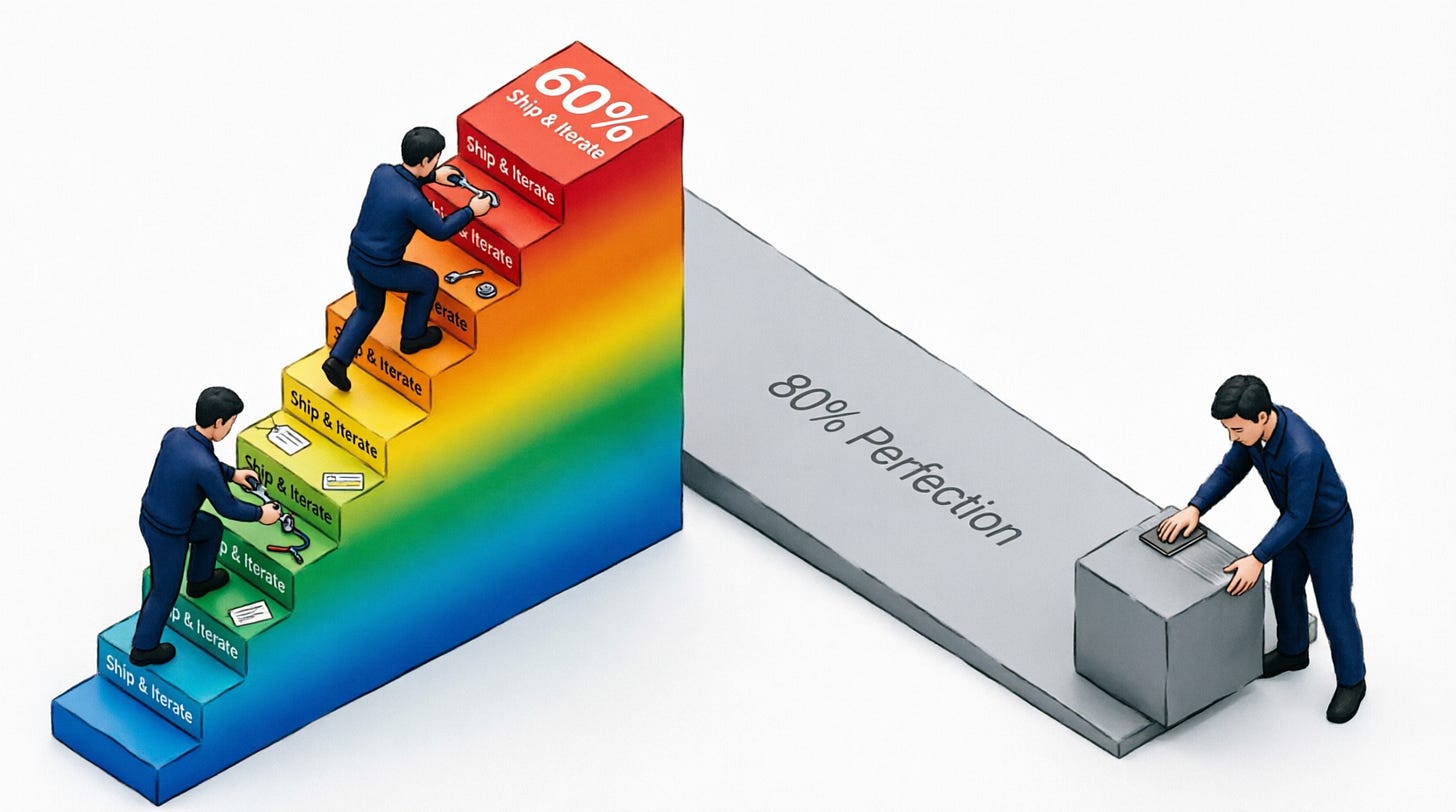
To escape the trap, one must move from refinement before release to iteration through release.
The math is simple: a less analytical peer who ships a 60% version, learns from the audience, and iterates will reach a 90% version long before the high-analytical person has shipped anything. The high-analytical person's 80% version, launched two years later, cannot compete with the iterated product.
The cure is not to be less intelligent, but to give intelligence a frame. Here are five concrete practices to manufacture that frame:
Define ‘Minimum Viable' in Writing: Define your shipping bar before you start the work, while you are not yet emotionally attached to the version you are building. Commit to shipping at that bar regardless of how much "better" you believe it could be.
Separate Generation from Editing: Create hard time cutoffs. Write or build for a fixed period without editorial judgment. Edit for a separate fixed period. In a high-analytical mind, the editorial function will kill the generative one if they run concurrently.
Commit Publicly to an Uncomfortable Date: Set a deadline before you are confident you can meet it. The social cost of missing the date must exceed the discomfort of shipping an imperfect thing.
The Monthly Embarrassment Metric: Deliberately ship one thing per month that you find slightly embarrassing. This recalibrates your "embarrassment detector," which is almost always miscalibrated upward.
Maintain a ‘Good Enough' Archive: Keep a folder of past work that felt unpolished when you shipped it but turned out to be successful. When you feel stuck, read it. Empirical evidence is more convincing than any theoretical argument.

The Cost of the Unlived Life
This trap is not limited to individuals. Organizations suffer from an institutional version of this paralysis. Companies that were once defined by a brilliant founding insight often develop an allergy to the "humiliation phase." They refuse to enter new markets or ship rough products because they are afraid of looking foolish. They analyze disruptive threats with perfect clarity, but they do nothing because doing something would mean being a clumsy beginner in a new domain.
Finally, we must name the cost of waiting. Staying stuck is not a neutral act of preservation. It feels like "keeping your powder dry," but in reality, optionality decays. Skills atrophy, networks thin, and the window for certain moves closes.
The person who waited for certainty did not avoid risk; they simply took the most silent, compounding risk of all: the risk of arriving at the end of a decade having optimized for the avoidance of small failures while missing the larger life. The smartest move is to realize that the safest-feeling path has its own steep and invisible price.