In 1989, Tim Berners Lee submitted a proposal to CERN management that his supervisor described, in a handwritten note on the cover page, as vague but exciting. The proposal was for a distributed information system, the World Wide Web, designed to allow scientists to share and access documents across disparate computer systems without the need for a central administrator. The fundamental philosophy was revolutionary: the network would be the system, not any particular machine sitting atop it.
The web that emerged from that vision was, for roughly fifteen years, an embodiment of the "End to End" principle. A concept in computer networking which suggests that the intelligence of a network should reside at the edges (the users and their devices) rather than in the core (the infrastructure providers).
In this era, the web was a pluralistic, chaotic, and remarkably free landscape. Pages linked to pages. Servers were owned by universities, hobbyists, small businesses, and individuals. The protocol was open, and the access, once the technical friction was cleared, was structurally equal. No one decided what you could publish; no one optimized your reading for dopamine driven return visits; and, perhaps most importantly, no one knew exactly who you were.
That internet is gone.
What replaced it is a different infrastructure with a different architecture, different power structures, and a fundamentally different relationship between the people who create content and the people who consume it. As we move through the mid 2020s, the question is no longer whether the open web is shrinking, but whether anything from the original vision is salvageable and what "salvageable" looks like in an age of algorithmic enclosure and synthetic intelligence.
The Architecture of Freedom: The Original Vision
The founding documents of the web were not merely technical manuals; they were political manifestos.
The early internet was built on four pillars:
Decentralization: no single point of failure or control.
Openness: protocols public, not proprietary.
End to end: intelligence at the edges of the network, not the center.
Universal access: anyone who could reach the network could use it.
These were engineering choices that mirrored the geopolitical climate of the time. The architects of the early internet were reacting against the mainframe era of computing, where immense power was concentrated in the hands of institutions like IBM or the military, with individuals accessing computational resources only on terms set by those institutions. The internet was built to be a bypass of that central authority.
This architecture produced a strange and pluralistic digital landscape. Before the consolidation of the mid 2010s, the web was characterized by a massive long tail of niche communities. Geographic and social isolation could be bridged via decentralized forums and personal websites.
This was the Digital Commons, a concept often compared to Elinor Ostrom's work on how communities manage shared resources without the need for top down regulation. The commercial web of the mid 1990s, Amazon, Google, and eBay initially acted as parasites on this open infrastructure; they were services built on top of the open web, but they did not own the underlying protocols. They relied on the open web to function.
The Three Forces of Enclosure
The transition from the open web to the walled garden was not a single, sudden event. It was a convergence of three distinct forces of enclosure: Platforms, States, and Capital.

The Platformization of Attention
The commercial web discovered that the most profitable model was not selling access to infrastructure, but selling access to aggregated human attention. This gave rise to the Platform Economy. Companies like Google, Meta, Apple, and Amazon did not just provide services; they created walled gardens.
Within these environments, the rules of engagement, the visibility of content, and the flow of revenue are controlled by a single entity.
By the mid 2010s, the openness of the web had become an illusion. While the infrastructure remained, the audience had migrated. A significant majority of time spent online in the United States is now spent within five or six super apps." In these spaces, you do not browse the web; you inhabit a platform.
The Rise of the "Splinternet"
Simultaneously, the state discovered that the internet was both a tool for civic mobilization and a threat to national sovereignty. We are witnessing the rise of the Splinternet. The fragmentation of the global internet into controlled national networks is happening in our lifetime.
China's Great Firewall is the most prominent example, creating a domestic internet that is technically isolated from the global whole.
However, the enclosure is not just an authoritarian phenomenon. In Western democracies, control is exercised through soft mechanisms: platform liability laws that incentivize aggressive censorship, data localization requirements that force data to stay within specific borders, and the massive expansion of surveillance infrastructure.
As revealed by the Snowden leaks in 2013, the architecture of the open web and the architecture of mass surveillance are disturbingly compatible.
Surveillance Capitalism
The most pervasive force is what Professor Shoshana Zuboff calls Surveillance Capitalism. To finance a free internet, the advertising model required the maximization of engagement. Maximizing engagement required extreme personalization. Extreme personalization required total surveillance.
The data used to make a Google ad precise is the same data that makes a political micro targeting campaign effective, which is the same data that state actors subpoena. The free web was never truly free; it was a trade-off where the user's behavioral data became the commodity.
The Erosion of the Digital Commons
As these three forces converged, the qualitative experience of the internet fundamentally changed. We have lost three essential dimensions of digital life:
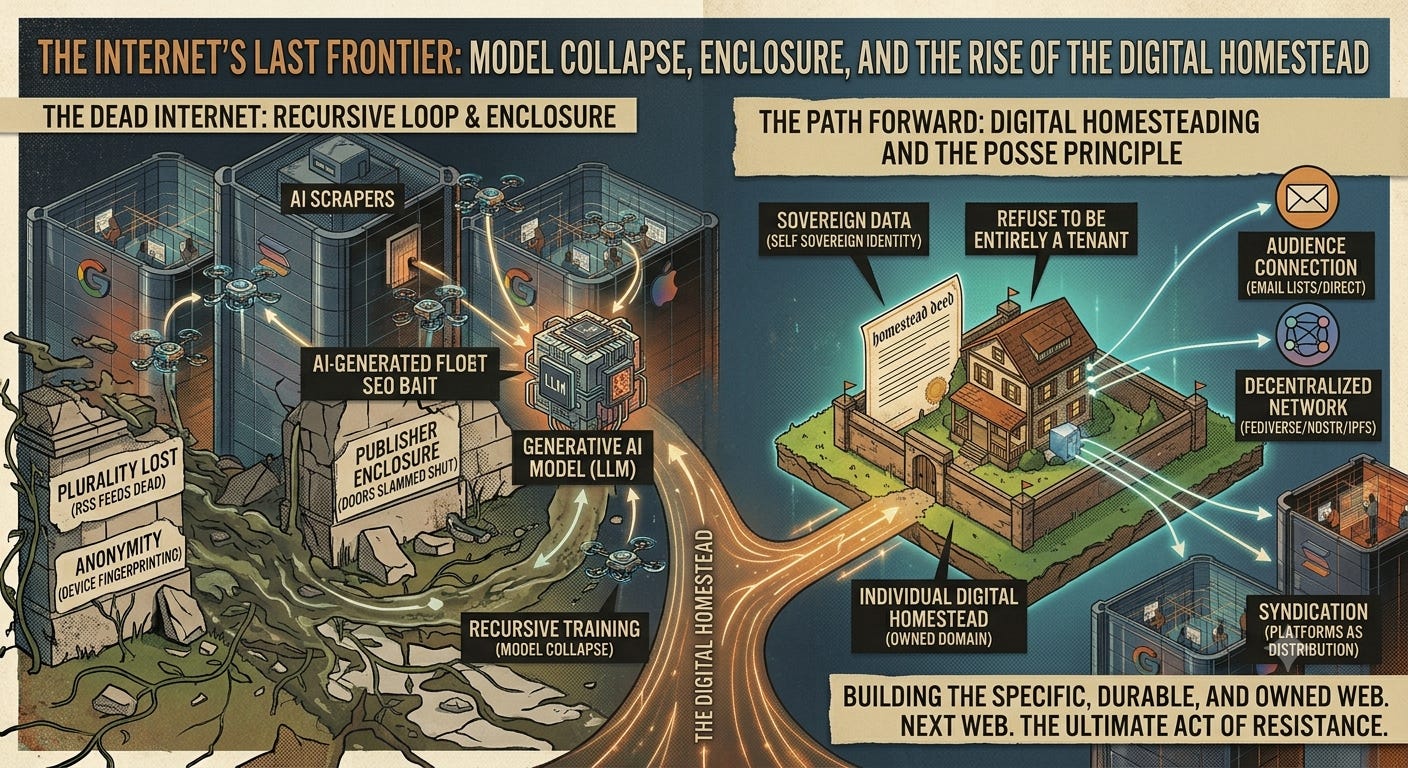
The Loss of Plurality: In 2005, a blogger could build a direct audience through RSS feeds and personal domains. In 2025, a creator is a tenant on a platform. To reach an audience, they must feed the algorithm, which dictates what is made and how it is seen. This creates a feedback loop where content is optimized for platform engagement rather than human value.
The Loss of Anonymity: The early web allowed for a degree of "pseudonymity" the ability to explore ideas without a permanent, verified identity. The modern web, via device fingerprinting, cookie tracking, and "Login with Google" mandates, has effectively killed the ability to be anonymous. We are no longer users; we are tracked subjects.
The Loss of Permanence (Digital Decay): The web was intended to be a permanent archive of human thought.

It is failing at this.
Research into link rot indicates that a significant percentage of web content, sometimes cited as high as 25-50% within a decade, is lost to dead links and broken paths. When platforms like GeoCities or Vine disappear, entire subcultures and historical records vanish instantly. We are building our digital culture on shifting sands.
The Final Frontier: The AI Scrapers and the Dead Internet
A fourth, more recent force has arrived, threatening to finalize the enclosure: the rise of Generative AI. This has led to a phenomenon increasingly described as the Dead Internet Theory. It is the idea that the internet is becoming a recursive loop of machine generated content.
We are entering an era of Model Collapse. As Large Language Models (LLMs) are trained on the content of the open web, they are increasingly being trained on content produced by other AIs. Research (such as that by Shumailov et al.) suggests that when AI models are trained on synthetic data, they eventually degrade, losing the nuance and variety of human thought.
This creates a double enclosure. On one side, publishers are slamming their doors shut. Fearing their content will be scraped to train models that will eventually replace them, media organizations are moving behind aggressive paywalls and bot blocking layers.
On the other side, the open part of the web is being flooded with synthetic filler. This wall of AI generated SEO bait that devalues human made signal is only making the problem worse. The web is becoming a place where machines read, rewrite, and repost each other, leaving humans to navigate a hall of mirrors.
The Path Forward: Digital Homesteading
If the enclosure is nearly complete, is there a way back?
The honest answer is that we cannot restore the 1990s. The technical and economic conditions that allowed for the open web, namely, the low technical barriers and low state/capital interest no longer exist.
However, we can build digital homesteads.
In the history of the American frontier, homesteading was the act of establishing a permanent, self-sufficient presence on land that you own. In the digital sense, this means moving from being a tenant to being an owner.
The POSSE Principle: "Publish on your own site, Syndicate elsewhere." The most durable digital presence is one where you own the domain and the content. Use platforms like X (Twitter) or TikTok for distribution, but use your own site or an email list for connection. If a platform dies or changes its algorithm, your audience remains with you.
Decentralized Protocols: Technologies like the Fediverse (using the ActivityPub protocol) allow for a federated social media experience. You can join a community (like Mastodon) that you can leave at any time, without losing your identity or your data. Similarly, projects like Nostr and IPFS are technical attempts to build a decentralized layer that no single corporation can turn off.
Sovereignty over Data: The rise of Self Sovereign Identity and decentralized technologies offers a glimmer of hope for regaining control over our digital shadows.

The Generational Memory Gap
The most profound danger is the generational memory gap. There is a risk that the splintered web will become the only web in the minds of the next generation. If you have never known an internet where you could build a space without a login, without a tracker, and without an algorithm, you cannot mourn the loss of that space. You will not know it is gone; you will only think the walls are the horizon.
The original web was, as Berners Lee's supervisor said, vague but exciting.
The next web must be specific, durable, and owned. We may never return to a truly open internet at a global scale, but we can refuse to be entirely a tenant. By maintaining our own domains, our own archives, and our own direct relationships with one another, we keep the flame of the original vision alive.
The act of ownership is, in an age of total enclosure, the ultimate act of resistance.
Verified Sources
Primary Sources & Technical Principles
Berners-Lee, T. (1989). Information Management: A Proposal. CERN. Link to CERN Archives
Saltzer, J. H., & Schroeder, M. D. (1978). The End-to-End Principle of System Design. [Reference to fundamental networking architecture]
Theories of Enclosure & Capitalism
Zuboff, S. (2019). The Age of Surveillance Capitalism: The Fight for the Future of the Human Race. PublicAffairs.
Ostrom, E. (1962). The Age of Information and the Digital Commons. [Applying Ostrom's principles to digital shared resources]
Research on Digital Decay & AI
Internet Archive (Wayback Machine): Research regarding "Link Rot" and the preservation of the web. archive.org
Shumailov, I., et al. (2023). AI models make mistakes when trained on AI-generated data (Model Collapse). arXiv:2305.17115
Data & Trends
Pew Research Center: Studies on social media usage and the "Platformization" of attention. pewresearch.org
Freedom House: Freedom on the Net reports regarding state-led internet censorship and the "Splinternet." freedomhouse.org