It is 3:17 a.m. and the mind has been running for two hours. It is not running on anything useful, not on the urgent logistics of the coming week or the resolution of a complex problem. Instead, it is looping on a conversation from last Tuesday, auditing a minor social misstep from three years ago, and simulating a hypothetical conflict that will almost certainly never occur.
The body is exhausted, heavy, and signaling a desperate need for rest, yet the mind interprets this exhaustion as mere background noise, it reads it as additional data to be processed, analyzed, and solved.
If this sequence feels familiar, you are not broken. You are running hardware that does not come with an off switch.
High analytical intelligence is a profound gift, but it carries a specific, measurable cost. To navigate the world as a high functioning thinker is to exist in a state of perpetual cognitive tension. The goal of understanding this condition is not to think less, which is physiological impossible for many, but to learn how to think with less suffering.
The Phenomenology of the Overthinking Mind
To describe the experience from the inside is to describe a state of constant, internal high frequency vibration.
There is the constant background simulation, rehearsing conversations for a meeting that is still three days away, playing out every possible permutation of the dialogue.
There is the replay loop, where social interactions are audited for subtext, tone, and unintended implications, generating a micro cringe for every frame of the memory.
There is the rapid fire counter argument, where a thought is not simply held, but is immediately challenged, defended, and undermined in a single cognitive breath.
For the hyper analytical, even leisure is colonized by the mind. It is difficult to listen to a piece of music or read a work of fiction without a parallel commentary track running an analysis on the structural symbolism, the quality of the composition, or whether you are experiencing the art in the correct, most efficient way.
And then there is the middle of the night clarity. That specific, terrifying brand of insight that feels like a revelation at 2:00 a.m. but reveals itself to be mere anxiety by 8:00 a.m.
Most overthinkers operate under the assumption that this is the human default, that others experience this same churning internal monologue and are simply better at hiding it.
They are not.
The high idle mind is a specific neurobiological configuration. Understanding that this is a specific trait, rather than a universal failure of character, is the first step toward relief.
The Neurobiology of the High Idle Mind
To understand why the mind refuses to quiet, we must look at the architecture of the brain, specifically the interplay between the Default Mode Network (DMN) and the Task Positive Network (TPN).
The TPN is the brain’s worker mode. It is active when we are focused on an external task, whether it’s solving a math problem, driving a car, or writing a report. When the TPN is active, the DMN, the part of the brain responsible for self referential thought, dreaming, and imagining is largely suppressed.
In the hyper analytical mind, the boundary between these two networks is porous. Research on the Default Mode Network shows that in individuals with high levels of rumination, the DMN remains hyper active even during tasks that require focus.
The mind fails to switch off because the DMN continues to run background simulations of the self and the past while the TPN tries to engage with the present. This is the neurological basis of the overthinking experience: the brain is effectively trying to run two different operating systems at the same time, leading to massive cognitive drag and exhaustion.
The Intelligence Anxiety Correlation
The relationship between high intelligence and psychological distress is a well documented, if uncomfortable, reality. The scientific literature suggests that analytical intelligence is not a neutral trait; it is a force multiplier for both competence and neurosis.
A 2015 study published in Personality and Individual Differences found that verbal intelligence was a significant predictor of worry and rumination, independent of the individual’s baseline neuroticism. In other words, being smart can actually increase the frequency of worrying, regardless of whether you are a naturally anxious person or not.
Furthermore, a 2012 study linked high IQ to higher rates of mood and anxiety disorders, suggesting that heightened environmental sensitivity, the ability to process complex environmental cues, is a key mediator.

This creates what can be termed the “Gift Tax Paradigm.” The same cognitive engine that allows for rapid pattern recognition, complex problem solving, and strategic foresight is the exact same engine that generates 4:00 a.m. inventories of personal failures. The brain does not distinguish between productive analysis (solving a problem at work) and maladaptive rumination (replaying a social error). It simply runs.
This is why the standard advice to just relax is not only unhelpful; it is a category error. Telling a hyper analytical person to just stop thinking is like telling someone with perfect pitch to stop noticing when a piano is out of tune. The trait is not separable from the suffering; the capacity for depth is the very thing that allows for the depth of the distress.
The Masking Problem: The High Functioning Paradox
A critical component of the thinker’s burden is its invisibility.
The people who carry this weight are often the most successful, the most composed, and the most reliable members of their professional and social circles. This is the Masking Problem.
The same cognitive horsepower that generates endless internal commentary also generates a polished external performance. High functioning overthinkers are masters of social camouflaging. They provide the calm, measured answer in the boardroom; they send the reassuring, steady email; they maintain a presence that others read as unshakable confidence.
However, this performance comes at a staggering metabolic and psychological cost. Underneath the composed surface, the machine is running every scenario, auditing every word for unintended implication, and managing a massive cognitive load required to maintain the mask.
This leads to a chronic misdiagnosis. Because these individuals are successful by every external metric, they are rarely flagged as struggling. They are promoted precisely because of the hyper vigilance that is simultaneously exhausting them. The mask works so well that it eventually becomes a trap: to drop the mask feels like admitting to a fraud, yet to maintain it feels like being slowly consumed by a machine that never sleeps.
Navigating the Loop: Evidence Based Interventions
If the goal is not to silence the mind, but to manage its direction, what does the evidence suggest actually works?
We must distinguish between optimization hacks (which the overthinking mind will simply turn into more things to overthink) and regulatory interventions.
1. Mindfulness and Cognitive Defusion
Mindfulness based interventions show moderate, consistent benefits in meta analyses, but with a caveat: they require significant, disciplined practice to move beyond a superficial relaxation effect. The most effective approach for the analytical mind is often Cognitive Defusion - a core component of Acceptance and Commitment Therapy (ACT).
The goal is not to stop the thought, but to change your relationship to it. Instead of being consumed by the thought “I am a failure,” the practitioner learns to observe: “I am having the thought that I am a failure.” This creates a microscopic but vital distance between the self and the cognitive loop.
2. Somatic Regulation and the Parasympathetic System
Because overthinking is a state of high sympathetic nervous system arousal (the “fight or flight” response), mental solutions are often insufficient. Somatic practices like vigorous exercise, cold exposure, or structured breathwork work by physically forcing the body into a parasympathetic state. A hard run does not stop the loop, but it changes the physiological context in which the loop occurs, making it less volatile.
3. The Primacy of Sleep
Sleep is the single most underrated intervention for the analytical mind. Chronic sleep deprivation degrades the prefrontal cortex’s ability to regulate the amygdala. In a sleep deprived state, the threshold for triggering the anxiety loop drops significantly.
Protecting sleep is not self care rhetoric; it is a fundamental requirement for neurological stability.
4. Pharmacological Intervention
For a significant subset of the population, the volume of the internal monologue is simply too loud for lifestyle changes to manage alone. For these individuals, SSRIs and other medications can reduce the signal to noise ratio, allowing them to engage in the therapeutic work that was previously impossible due to sheer cognitive overwhelm.
Five Practices for the High Idle Mind
To move from being consumed by the mind to being directed by it, one must move from thinking to disciplined directing.
First: Protect Sleep Ruthlessly. Eight hours is the non negotiable baseline. The processing of the day’s data will be more efficient, and the emotional regulation more robust, if the hardware is allowed to cool.
Second: The Daily Cognitive Dump. Every morning, before engaging with any digital input, engage in ten minutes of unfiltered, manual writing. Not “journaling” (which is often an attempt to find meaning), but a data dump - a raw externalization of the current mental load onto paper. The act of moving thoughts from internal working memory to an external medium reduces the internal cognitive load.
-
Third: Scheduled Worry Time. This is a highly effective cognitive containment strategy. Allocate a specific, twenty minute window in the afternoon to allow the mind to run through its list of concerns. Outside of that window, when a worry arises, use the rule: Not now; I have a scheduled time for this. This allows the mind to defer rather than suppress.
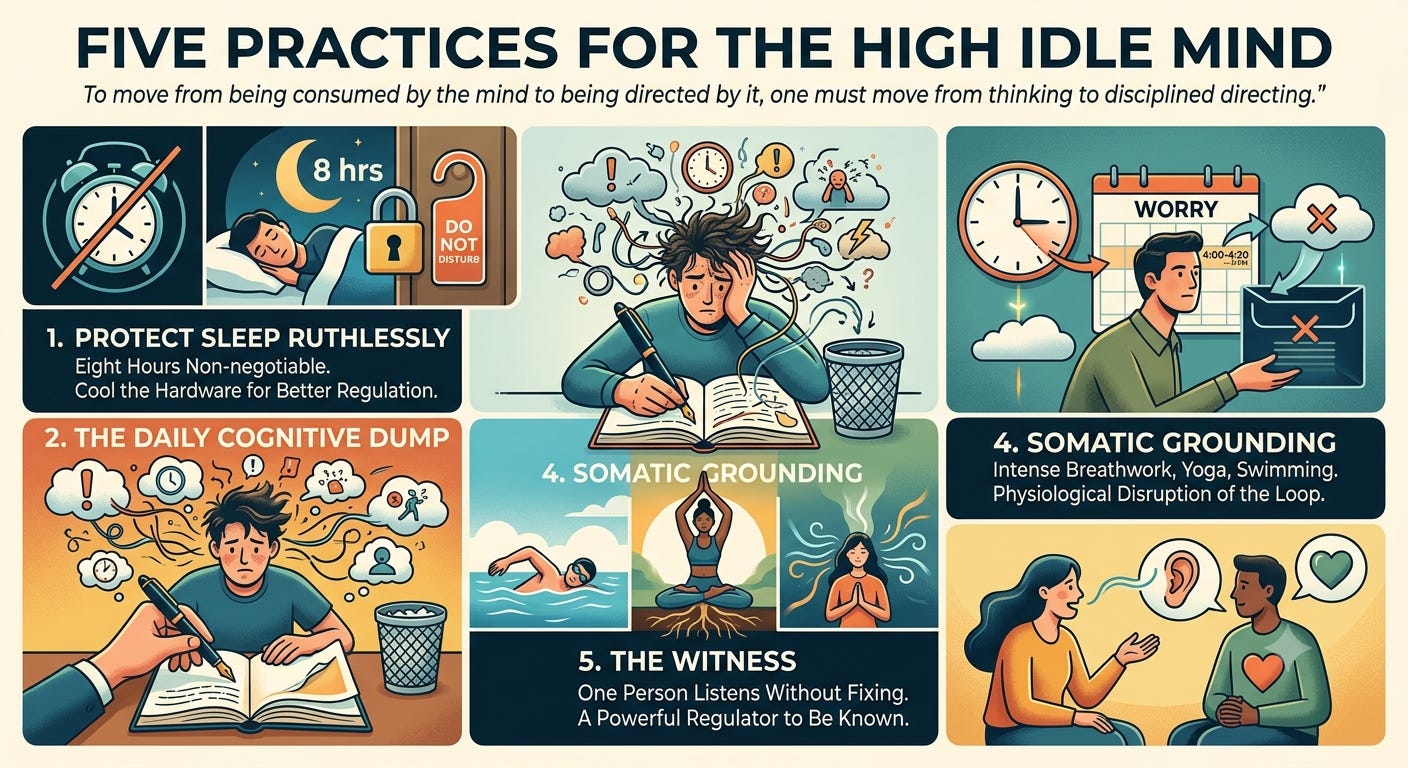
Fourth: Somatic Grounding. Engage in at least one practice several times a week that forces the focus from the head into the body: swimming, yoga, or even intense breathwork. The objective is to break the loop through physiological disruption.
Fifth: The Witness. Cultivate one person, a partner, a friend, or a therapist, who can listen to the loop without the urge to fix it. The goal is not to solve the thought, but to have the experience witnessed. The recognition that the loop is a known phenomenon, rather than a unique madness, is a powerful regulator.

When the Burden Becomes the Edge
It would be a disservice to frame the overthinking mind solely as an affliction. In the right conditions, the very traits that cause suffering are the source of exceptional value.
The same relentless scenario running that ruins a Sunday evening is what identifies a fatal flaw in a business strategy before it is implemented. The same sensitivity to subtle social cues that makes small talk exhausting is what makes a person an extraordinary negotiator, a nuanced writer, or a deeply empathetic leader.
The trait is not a bug to be eliminated; it is a powerful instrument that is, by default, pointed at the wrong target - inward, at the self, on an infinite loop.
The discipline that turns the burden into an edge is AIM. When the analytical drive is directed at an external problem with a deadline and a boundary, it is a superpower.
When it is directed at the self with no boundary and no deadline, it is a trap. The work of a lifetime is not to dampen the engine, but to give it something worthy and finite to run on and to build the off switch that allows the machine to rest when the work is done.
Verified Sources & References
Academic References:
Andrews-Hanna, J.R., et al. (2014). The Default Network and Self-Generated Thought. Annals of the New York Academy of Sciences. (Discusses the role of the Default Mode Network in self-referential thought and its implications for cognitive distraction).
Karpinski, R.I., et al. (2018). High Intelligence: A Risk Factor for Psychological and Physiological Overexcitabilities. Intelligence. (Examines the correlation between high cognitive ability and increased sensitivity to environmental and internal stimuli).
Khoury, B., et al. (2013). Mindfulness-Based Therapy: A Comprehensive Meta-Analysis. Clinical Psychology Review. (Provides empirical evidence for the efficacy of mindfulness-based interventions in reducing anxiety and rumination).
Penney, A.M., et al. (2015). Intelligence and Emotional Disorders: Is the Worrying and Ruminating Mind a More Intelligent Mind? Personality and Individual Differences. (A foundational study on the link between verbal intelligence and the tendency toward rumination).
Additional Theoretical Context:
American Psychological Association (APA). The Impact of Rumination on Anxiety and Depression. (General consensus on the mechanics of maladaptive thought loops).
Dabrowski, K. (1960). Theory of Positive Disintegration. (A psychological framework regarding “overexcitabilities” in highly sensitive, highly intelligent individuals).