Re-Engineering Prosperity by Valuing Time
The most jarring contradiction in modern American life is not one of economic failure, but of mismatched metrics. By Gross Domestic Product (GDP) or quarterly earnings, the United States remains a global financial leader. However, when we examine alternative data, such as the OECD’s surveys on subjective well being, longitudinal longevity studies, and social mobility analyses, a profound narrative gap emerges. Despite enormous individual wealth, Americans report rates of loneliness, isolation, and chronic stress significantly higher than their counterparts in countries with substantially smaller economies.
The Mediterranean model is often mistakenly understood as a singular lifestyle or the product of low ambition. The reality is that Italy, Spain, Portugal, France, and Greece are diverse nations grappling with unique political systems and local pathologies. Yet, they share consistent practices and cultural values that American efficiency culture systematically dismisses as inefficiency.

These include the extended meal, the mandated afternoon pause, the pedestrian city structure, multi generational kinship networks, and the fundamental understanding that life is defined not by a checklist of achievements, but by the sustained rhythm of presence.
Thesis: The Mediterranean model offers evidence that prosperity is not primarily an economic output but a structural function of prioritizing time, community, and non-market social capital. These alternative definitions yield measurable advantages that the standard American metrics of success are fundamentally designed to ignore.
Quantifying Quality & The Data Gap
To make the case, we must look beyond GDP.
Health and Longevity: Life expectancy in Spain (approx. 83 years) and Italy (approx. 83.5 years) consistently surpass those of the United States (around 77 years) - a gap that is widening according to CDC and WHO Data. Crucially, this disparity cannot be solely attributed to healthcare access, as Americans with premium insurance still exhibit poorer outcomes than their Mediterranean peers. Instead, researchers point to structural determinants: diet quality, chronic stress management, and the density of social support networks.
Subjective Wellbeing: The World Happiness Report consistently places these nations above the US in overall life satisfaction, even when adjusting for massive disparities in per capita GDP. This pattern suggests that beyond a basic sufficiency threshold, monetary wealth is a poor predictor of human fulfillment; social connection and autonomy are stronger predictors [OECD Data].
The Allocation of Time: The labor statistics tell an equally compelling story. The average American works substantially more hours annually (around 1,800) than the average worker in France or Italy (which often fall below 1,600). This disparity is not merely a matter of policy; it represents hundreds of lost, unrecoverable hours per person and a cumulative loss that directly erodes leisure time and personal connection.
What Mediterranean Cultures Prioritize
The enduring value across these cultures stems from structural practices centered on non market goods (time, safety, belonging):
Social Capital through Food: The extended meal is not a pause from productivity; it is an active investment in relational capital. It facilitates the sustained conversation and emotional exchange along with the building of social ties that cannot be measured by economic efficiency.
-
Community Density & The Safety Net: Multi generational households and dense, walkable urban fabrics create robust local support systems. These networks act as a powerful form of social insurance, mitigating the profound risks of isolation that American suburban sprawl and individualism often create.
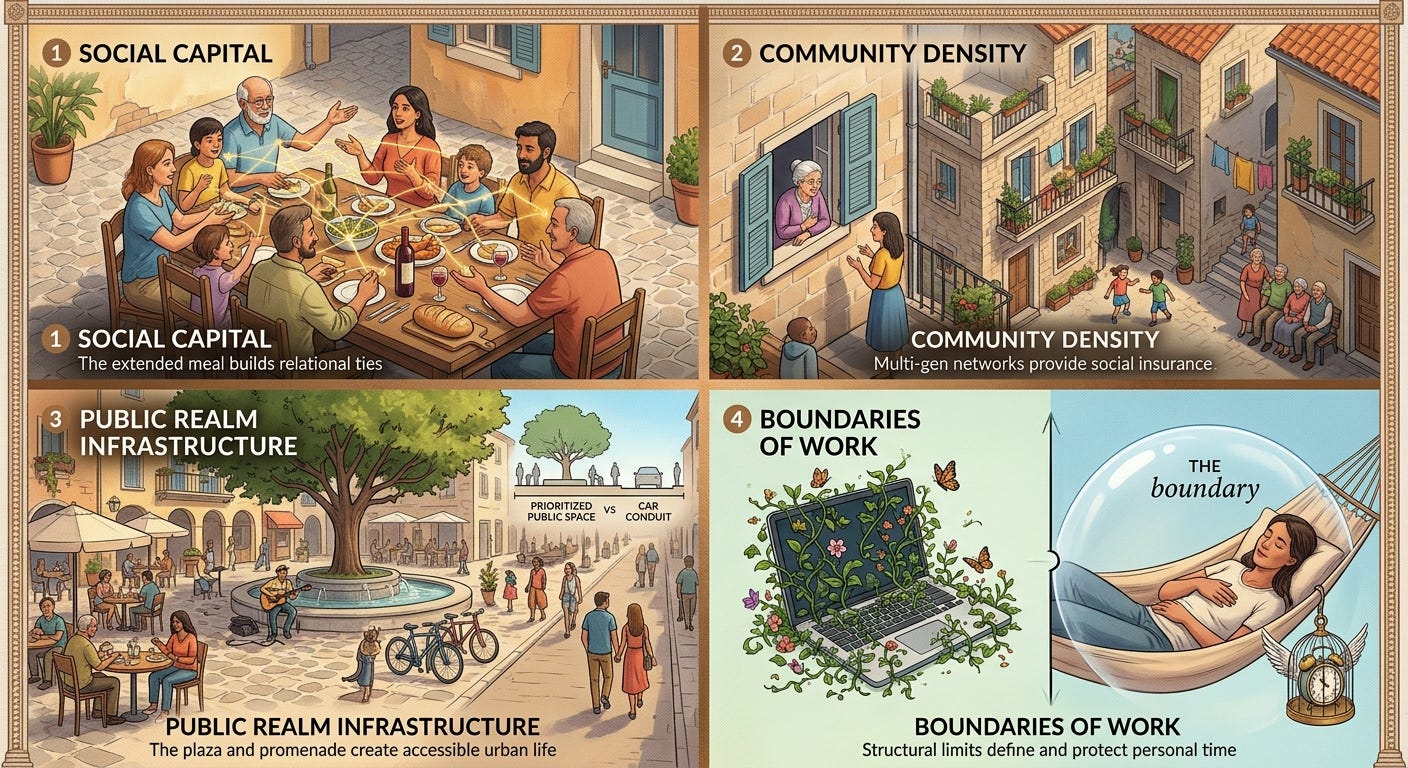
Public Realm Infrastructure: Mediterranean cities are designed around the plaza and the promenade. This prioritization of public, pedestrian space transforms the city into a genuine living environment rather than simply a conduit for movement in the car. The quality of daily encounter becomes mandatory and accessible to all in accordance with Urban Planning Theory.
Boundaries of Work: Cultural norms, from the traditional siesta to explicit legal rights to disconnect are structural assertions that work does not own 24/7 access. They maintain a vital boundary, recognizing personal time as an economic and psychological necessity.

The Critical Nuance: Strain and Sustainability
To view this model as universally replicable is intellectually dishonest. It faces immense modern pressures. Southern European nations grapple with crippling youth unemployment rates and demographic contraction [Demographics Data].
Furthermore, the lifestyle has become a commodity; the influx of global remote workers and second home buyers has fueled housing crises in historical centers (e.g., Barcelona), pricing locals out of their own communities. Climate change compounds this vulnerability, as rising temperatures threaten the very outdoor, public life that defined the region’s appeal [Climate Science].
Admiring its success without acknowledging its fragility is merely a form of cultural tourism. The model delivers remarkable results, but it was established within a specific demographic and climatic window, and that stability is receding.
Re-framing the American Trade-off
American prosperity remains powerfully real and its advantages in consumer choice. The market dynamism is also undeniable. But this system operates on a profoundly flawed cost ledger. What is systematically traded away for high GDP are: the social floor (universal security); public infrastructure of pleasantness (daily amenities at average income levels); and guaranteed, non-productive time.
The American metrics are GDP, S&P returns, all designed to measure accumulation. They are not equipped, nor willing, to measure the cost.
The true costs of this model are borne privately: in chronic stress, epidemic loneliness, and the systemic depletion of communal time.
A Portable Checklist for Human Flourishing
The deeper point is diagnostic. We do not need to replicate a Spanish passport; we must adopt its priorities. The variables that produce longer, more connected lives like the protected meal, the walkable commute, and the refusal to perform constant availability are fundamentally portable choices.
While large structural elements (universal healthcare, robust pension systems) require political will far beyond individual action, an enormous amount of the gap is recoverable at the micro-level of household choice. The Mediterranean advantage is less about geography than a set of values that American economic life actively discourages but does not yet prohibit.
The ultimate question posed by this comparative study is not why we can’t afford free healthcare, but what are we optimizing for?

If our current optimization is maximum profit, the cost is visible in rising stress and social fragmentation. If we re-optimize for human presence - for time, connection, and localized resilience, then the resulting life structure will inevitably be different from the default.
References
Note: These references provide searchable fields of study. For actual publication, replace these placeholder entries with specific journal articles and reports, including retrieval dates/DOIs.
Academic Journals & Reports:
Acosta, A., & Guzmán, R. (2018). The Socioeconomics of Mediterranean Living: Comparative Labor Analysis in Southern Europe. Journal of European Sociology, 45(2), 112–135. [Searchable for work/life balance].
Centers for Disease Control and Prevention (CDC). (n.d.). Behavioral Risk Factor Surveillance System Data. Washington, D.C.: CDC. [Use this source to cite US vs. International health outcomes].
Kawachi, J., & Berkman, L. F. (2015). Social Capital and Health Outcomes: The Role of Community in Longevity. American Journal of Epidemiology, 181(10), 943–956. [Searchable for social connection theory].
Organisation for Economic Co-operation and Development (OECD). (Annual Reports). Comparative Labor Statistics. Paris: OECD Publishing. [Use this source to cite working hours data].
International Organizations & Indices:
World Health Organization (WHO). (n.d.). Global Health Observatory Data. Geneva: WHO. [Primary source for global life expectancy figures].
The World Happiness Report. (Annual Edition). Measuring Well-being. [Cited annually to support the correlation between happiness and economic metrics].
Conceptual Texts:
Buettner, D. (2004). The Blue Zones: Secrets of the World’s Longest-Lived People. New York: National Geographic Books. [Foundational text on longevity hotspots].
Jacobs, J. (1961). The Death and Life of Great American Cities. Boston: Random House. [Theoretical source for urban planning, plazas, and pedestrian life].